

Wedgewood Pharmacy, a New Jersey veterinary compounding pharmacy, on Wednesday, Oct. 21, recalled nearly 4,000 product listings shipped since February because its own laboratory data could not confirm they contain the labeled dose, a nationwide alert that lands as Boston dogs head into a week of overnight lows in the upper 30s.
What was recalled
The recall, posted by the U.S. Food and Drug Administration the same day, covers compounded veterinary medications that are still within their expiration dates and were shipped between Feb. 18 and Oct. 6, 2026, to veterinary practices, pharmacies and other customers across the United States. Wedgewood Pharmacy LLC is based in Swedesboro, N.J. The affected products span powders, pastes, oral suspensions, injectables, ophthalmic ointments and solutions, ear solutions and suspensions, and topical sprays and gels, intended for companion animals, horses, exotics, zoo and wildlife species and aquatic animals. None are intended for food-producing animals.
The veterinary trade publication dvm360 counted nearly 4,000 individual product listings in the recall, a figure that reflects listings rather than lots. Wedgewood has published a searchable lookup at wedgewood.com/recall-lookup with affected products, lot numbers and expiration dates, and the American Veterinary Medical Association posted its own alert on Oct. 21 directing veterinarians to that list.
Why it happened and what is known about harm
Wedgewood said the problem surfaced through its internal quality processes: inconsistencies in the reliability of its laboratory’s analytical testing data mean some products may be subpotent, containing too little active ingredient, or superpotent, containing too much. In the company’s words, a subpotent product may be ineffective and a superpotent one may cause toxicity or overdose. The company reported 98 complaints to date, seven of them classified as serious. It has not described the complaints, named the products involved or broken them down by species. The FDA notice states the recall is being conducted with the agency’s knowledge.
dvm360 noted a prior episode: in December 2022, Wedgewood Village Pharmacy recalled compounded omeprazole combination oral suspensions for containing less omeprazole than labeled.
What owners and veterinarians are being told to do
For pet owners, the instructions are short. Stop giving the product, keep it rather than discard it, and call the recall line run by Sedgwick, the third-party firm coordinating the recall, at 866-562-5931, Monday through Friday 8 a.m. to 9 p.m. ET and Saturday 9 a.m. to 5 p.m. ET. Sedgwick is notifying customers by email and mail and arranging refunds or replacements where possible. Anyone with a medical concern about an animal should contact their veterinarian, and adverse reactions can be reported to the FDA at 1-888-FDA-VETS.
Veterinary practices and pharmacies are asked to check inventory against the lookup, quarantine affected product, contact recall services and notify clients who received it. Wedgewood says it is working with veterinarians to identify clinically appropriate alternatives; clinical questions are being routed to the company’s care team rather than to Sedgwick.
The practical difficulty for dog owners is that compounded medications rarely carry a familiar brand name. They are prescribed when a veterinarian needs a strength, flavor or form that is not sold commercially, and the label is typically the pharmacy’s own. Owners who are unsure whether a prescription came from Wedgewood should call the prescribing clinic, which will have the dispensing record.
The cold arrives on schedule
The recall coincides with the first sustained cold of the season in New England. The National Weather Service forecast for Boston issued Friday, Oct. 23, calls for a low near 37 Friday night, highs of 58 Saturday and 62 Sunday with lows near 40 both nights, a warmer Monday near 67, then a drop to 53 on Tuesday with a low near 37 and another 53-degree day Wednesday. The region’s first hard chill came a week earlier: NBC Boston’s forecast for the Oct. 17-18 weekend called for temperatures below freezing across much of southern New England on Saturday night with northwest gusts to 45 mph.
The AVMA’s cold-weather guidance is specific about which dogs feel it most: young, old, ill or thin animals, short-haired and short-legged breeds, arthritic dogs that struggle on ice, and pets with diabetes, heart or kidney disease or hormonal conditions such as Cushing’s disease. Those are also the dogs most likely to be on long-term prescriptions, which makes this a week for two checks at once.
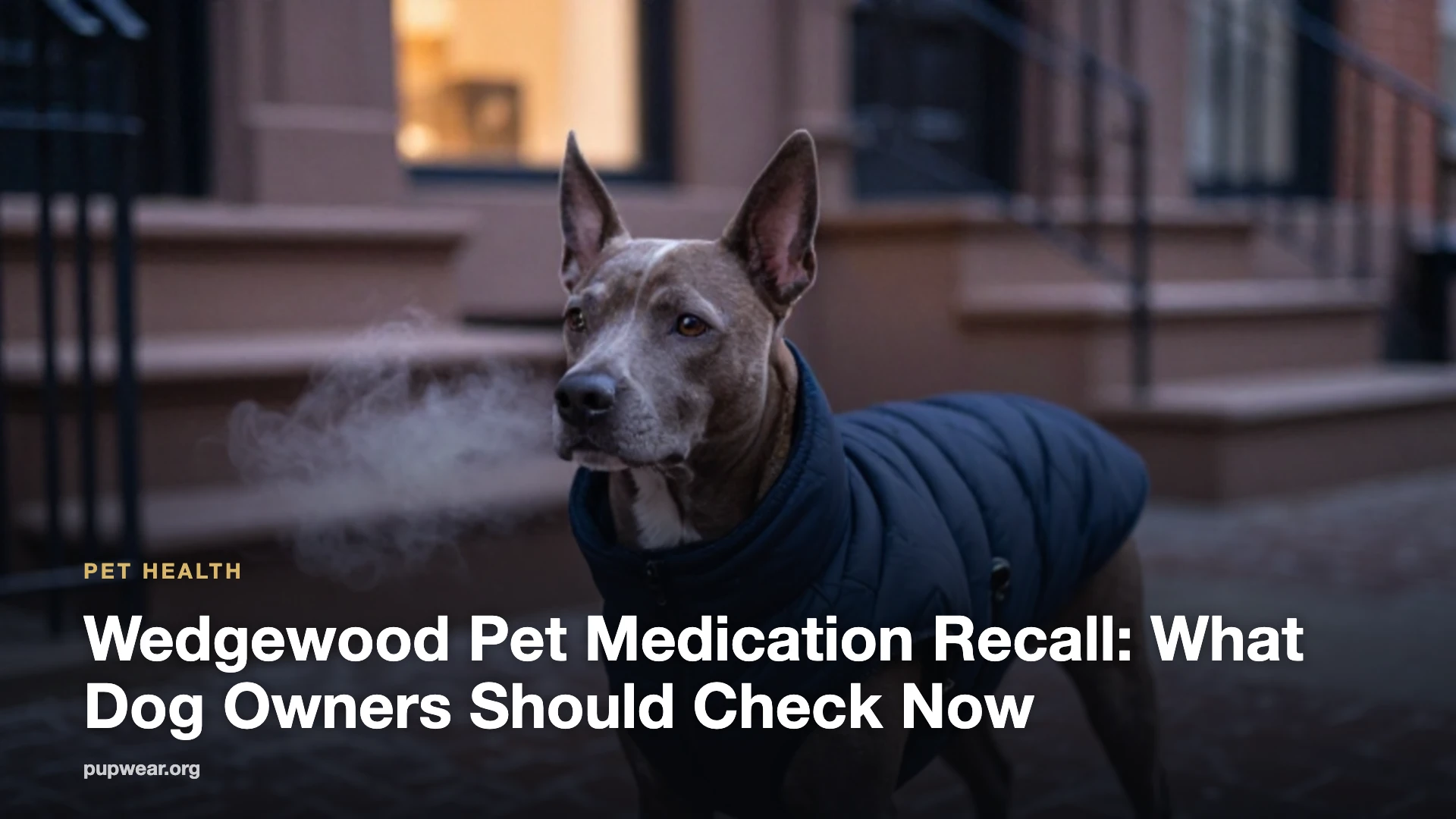
On apparel, the AVMA says short-coated dogs may benefit from a sweater or coat and recommends keeping several on hand so a dry one is available for every outing, because “wet sweaters or coats can actually make your dog colder.” Booties can protect feet but must fit properly. Owners should check paws for cracked or bleeding pads, treat sudden lameness on a walk as a possible sign of ice between the toes, and consider trimming the hair there. Walks should be shortened in very cold weather, and no pet should be left outside for long periods below freezing. Signs of hypothermia include whining, shivering, anxiety, slowing down or stopping, and searching for warm places to burrow; frostbite can take days to show. The AVMA also warns that cold cars chill pets quickly and that even small amounts of antifreeze can be fatal.
The PUPWEAR Take
Two things on this week’s list look unrelated and are not. The dogs the AVMA flags as cold-vulnerable, seniors, thin dogs, dogs with diabetes, heart or kidney disease and Cushing’s, are often the dogs with a prescription bottle in the kitchen. Some of those prescriptions are compounded because the commercial dose does not fit a 9-pound terrier or a 90-pound senior. A phone call to the clinic to confirm the pharmacy of record is a five-minute task that belongs on the same checklist as pulling the winter jacket out of the closet.
The AVMA’s dry-coat rule is the detail that changes how people should shop. One jacket is a wardrobe item; two is a system, because a coat that got wet on the 7 a.m. walk is colder than no coat at 6 p.m. Fit matters as much as fill: a jacket that rides up exposes the belly and chest of the short-legged dogs the guidance singles out. Reflective trim earns its place as sunset moves earlier through November. And an ID tag with a current phone number is cheap insurance in a week when a dog on a changed medication may behave differently than its owner expects.
What it means for you
- If your dog takes a compounded medication, call the prescribing clinic this week to confirm the pharmacy and lot, or search the lookup at wedgewood.com/recall-lookup.
- Do not stop a medication without talking to your veterinarian; the FDA and Wedgewood both direct medical questions to the prescribing vet.
- Keep two coats in rotation for short-haired, senior or thin dogs so a dry one is always ready, per AVMA guidance.
- Check paws after walks on frosty or salted sidewalks, and treat sudden limping as a reason to head home.
- Boston lows near 37 are forecast Friday and Tuesday nights; plan shorter evening walks on those days.
Test yourself
1. What date range of shipments does the Wedgewood recall cover?
Answer: Products shipped from Feb. 18 through Oct. 6, 2026, that are still within their expiration dates.
2. How many complaints has Wedgewood reported, and how many were serious?
Answer: 98 complaints to date, seven of them classified as serious.
3. Why does the AVMA recommend owning more than one dog coat?
Answer: So a dry one is always available, since a wet coat can make a dog colder than no coat.
4. Which number takes recall calls from pet owners?
Answer: Sedgwick’s recall line, 866-562-5931, weekdays 8 a.m. to 9 p.m. ET and Saturdays 9 a.m. to 5 p.m. ET.
Discussion
- Should compounding pharmacies be required to label products with a recall-lookup code owners can scan at home?
- At what temperature does your dog actually need a coat, and how do you decide?
- Should veterinary clinics be obligated to contact every client who received a recalled product, or is a public lookup enough?
From the network
- Boston Made Reader — every story from the family in one free reading app.
- Boston Made Pets — pet news, guides and local resources from the Boston Made family.
- Boston Made — the parent company behind PUPWEAR and its sister brands.
Sources
- U.S. Food and Drug Administration — Wedgewood Pharmacy Issues Recall of Certain Compounded Veterinary Medications Within Expiry
- dvm360 — Wedgewood recalls nearly 4,000 compounded veterinary products over drug potency concerns
- American Veterinary Medical Association — Recall alert: Wedgewood compounded veterinary medications
- American Veterinary Medical Association — Cold weather animal safety
- National Weather Service — Boston 7-day forecast
- NBC Boston — Rain, then freezing cold in Boston weekend weather forecast













Leave a Reply