

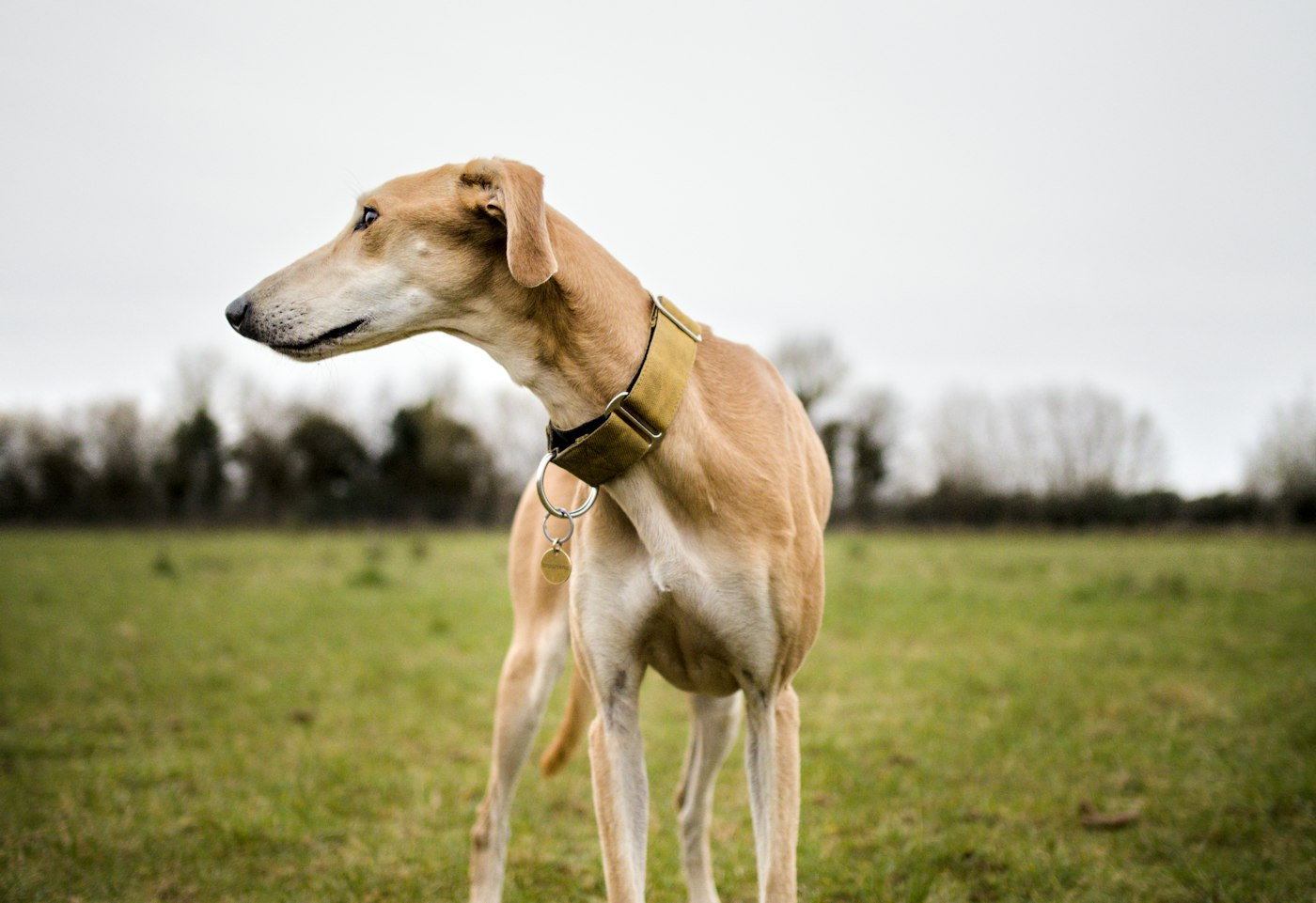
Some dogs have heads that are narrower than their necks, or simply know how to back out of a regular collar in a flash. For those dogs, a martingale collar can be a helpful option. Martingales are sometimes called limited-slip collars, and they are popular with owners of sighthounds such as Greyhounds and Whippets. Here is how they work and what to know before using one.
How a martingale works
A martingale collar has two loops. The larger loop goes around your dog’s neck. A smaller loop, called the control loop, connects to the larger one with two rings, and the leash clips to the control loop. When your dog pulls or backs away, the control loop draws the larger loop tighter around the neck, up to a set limit. When the tension eases, the collar loosens again.
The key is that the tightening is limited. Unlike a slip or choke chain, a properly fitted martingale should not keep tightening. It is designed to become just snug enough that your dog cannot slip out of it, not to choke.
Who martingales are for
- Dogs whose heads are about the same width as, or narrower than, their necks, such as many sighthounds
- Dogs who have slipped out of flat collars before
- Nervous or newly adopted dogs who might back out of a collar when frightened
Martingales are not a training tool for correcting pulling. They are a way to keep a collar on securely. For dogs who pull hard, many trainers suggest a harness along with loose-leash training.
How to fit a martingale
Fit is crucial. Adjust the collar so that it slides over your dog’s head when the control loop is loose. When the control loop is pulled tight, the collar should be snug around the neck but not tight, with room to slide a finger or two underneath. The two rings of the control loop should not touch when tightened. If they meet, the collar is too loose to prevent escape. If the collar is tight against the neck before the loop is fully drawn, it is too small.
Check the fit with your dog standing calmly, and recheck after grooming or weight changes.
Safety tips
Because the control loop hangs loose when there is no tension, martingales can catch on objects. Many manufacturers and trainers recommend that martingales be worn only during walks and supervised activities, and removed when your dog is home alone or in a crate. Some dogs wear a separate flat or breakaway collar with ID tags at home.
- Do not tie a dog out on a martingale.
- Remove it during rough play with other dogs, since a loop can catch on teeth or paws.
- Inspect the fabric, stitching and rings regularly.
- Keep ID tags on a collar your dog wears at all times, or attach them to the larger loop if your martingale is the everyday collar.
If you are unsure whether a martingale is right for your dog, a trainer or your veterinarian can help you decide.












