

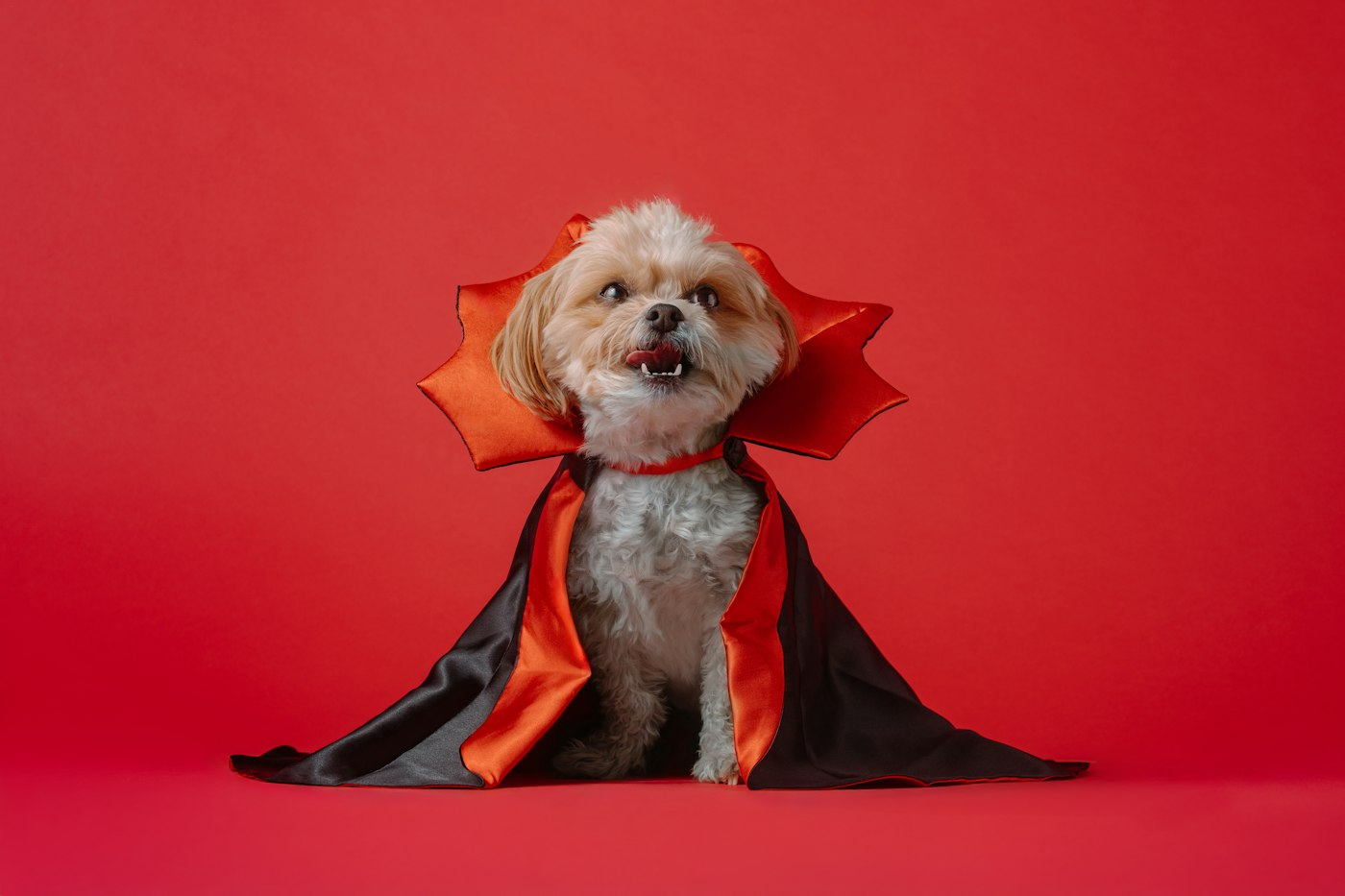
Halloween costumes for dogs range from simple bandanas to full outfits with hats and capes. Some dogs take them in stride. Others find them confusing or stressful. A good costume is one that keeps your dog safe, comfortable and able to behave like a dog.
Start with your dog’s personality
Before you shop, think honestly about your dog. Do they tolerate jackets and harnesses easily, or freeze when something new touches them? Dogs who are anxious, sensitive to handling or easily overwhelmed may be happier with a festive collar or bandana instead of a full costume. That is a perfectly good way to join the fun.
What makes a costume safe
- Free movement. Your dog should be able to walk, run, sit, lie down and relieve themselves normally.
- Clear vision and hearing. Avoid masks, hoods or hats that cover the eyes or ears.
- Easy breathing. Nothing should wrap around the muzzle or press on the throat.
- No small, chewable parts. Buttons, bells, sequins and loose decorations can be swallowed.
- No long dangling pieces. Capes, ties and fringe can snag on furniture or trip your dog.
- Breathable fabric. Dogs can overheat in heavy or synthetic outfits, especially indoors.
Check that the costume does not cover or block your dog’s collar and ID tags. If your dog slips away during a busy evening, their identification needs to be easy to find.
Fitting the costume
Measure your dog the same way you would for a jacket, usually around the neck, around the widest part of the chest and along the back. Check the fit closely once it is on. You should be able to slide a couple of fingers under any strap or elastic. Watch the areas behind the front legs and under the belly for rubbing.
Introduce it gradually
Do not wait until Halloween night for the first try. Starting a week or two ahead:
- Let your dog sniff the costume and reward them with treats.
- Drape it over their back briefly, reward, then remove it.
- Fasten it for a few seconds, then a minute, building up slowly.
- Keep the mood light and stop before your dog shows stress.
Signs to take it off
Remove the costume if your dog freezes, tries to back out of it, scratches or bites at it, tucks their tail, pins back their ears, yawns or lip-licks repeatedly, or simply stops acting like themselves. Some dogs will tolerate a costume for a quick photo and nothing more. Respect that.
On the night itself, supervise your dog the whole time they wear a costume. Take it off before they are left alone, crated or settled for the night. If your dog chews and swallows any part of a costume, call your veterinarian, since fabric and small parts can cause stomach or intestinal problems.
The best Halloween costume for your dog is one they barely notice. If that turns out to be just a bright collar, your dog is still dressed for the occasion.












