

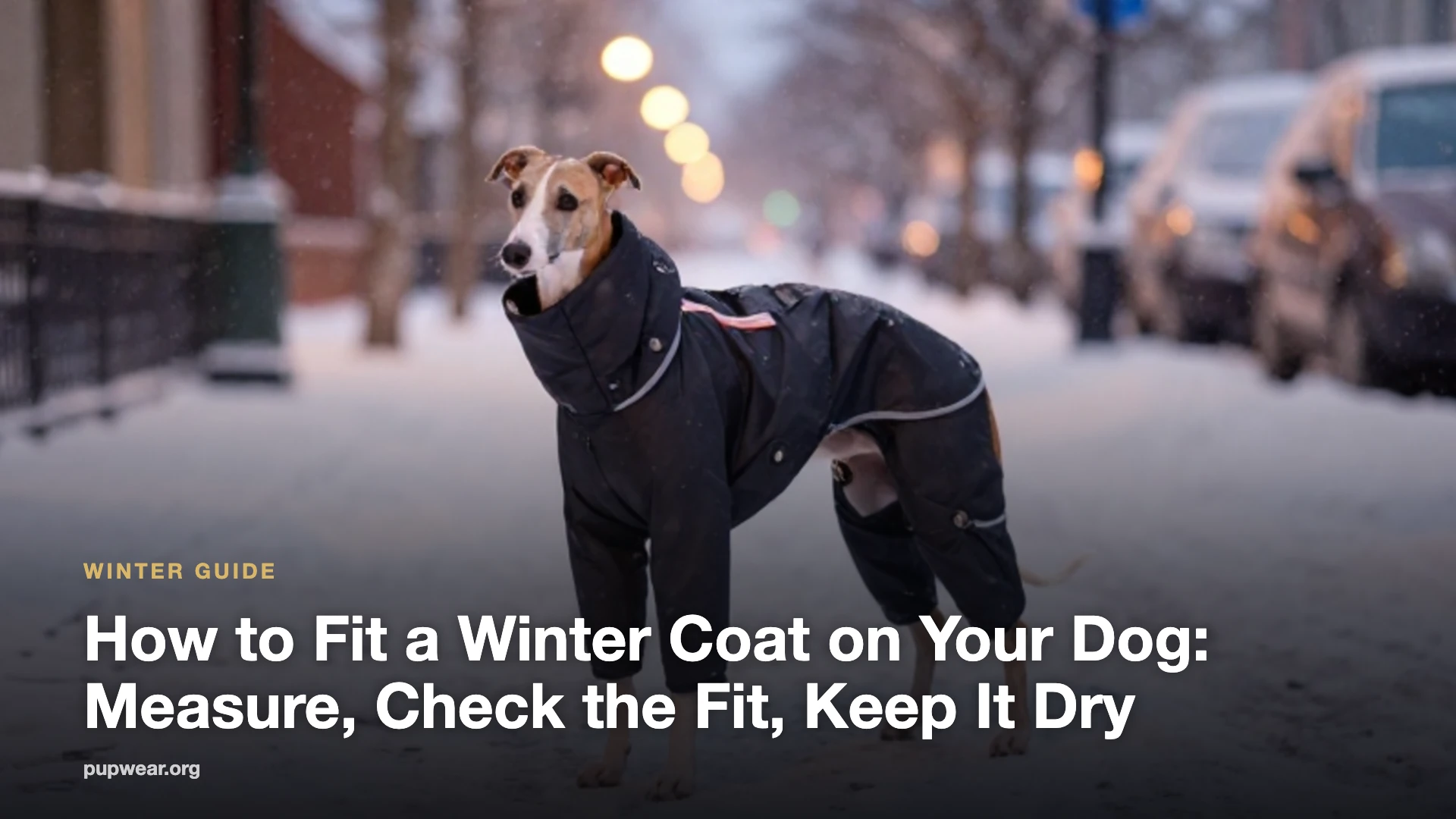
A winter coat helps some dogs a great deal and others not at all, and for the dogs that need one, the benefit depends on three measurements, a few fit checks at home and keeping the coat dry.
Which dogs a coat actually helps
The American Veterinary Medical Association (AVMA) says short-haired pets feel the cold faster because they have less protection, that short-legged pets may become cold faster, and that very young and very old pets are more vulnerable as well. Pets with diabetes, heart disease, kidney disease or hormonal imbalances may have trouble regulating their body temperature, the AVMA adds, and it suggests a sweater or coat for dogs with short coats or dogs that seem bothered by the cold.
The American Kennel Club names the likeliest candidates: small and toy breeds; hairless breeds; dogs clipped short, such as Poodles; low-slung breeds like Dachshunds and Corgis, whose bellies brush snow; lean sighthounds such as Greyhounds and Whippets; short-coated sporting breeds like Vizslas; and puppies, seniors and dogs with conditions such as arthritis. VCA Animal Hospitals gives a nearly identical list.
Thick, double-coated breeds such as Alaskan Malamutes, Newfoundlands and Siberian Huskies are generally protected by their fur, the AKC says, and PetMD warns that dense-coated dogs forced into extra layers can overheat. The AKC adds that no single temperature is too cold for every dog, while Hill’s Pet Nutrition treats the mid-40s Fahrenheit as the point to start dressing the dogs that need it.
Measure three numbers, with the dog standing
The AKC’s measuring guide and VCA describe the same core measurements:
- Back length: along the top of the spine, from the base of the neck where it meets the body to the base of the tail.
- Chest girth: around the widest part of the rib cage, just behind the front legs. The AKC calls this the most important measurement for clothing and harnesses.
- Neck: around the neck where a collar sits. VCA notes that some jackets ask for it and others do not.
The AKC recommends measuring with the dog standing, so the spine is straight. VCA and the AKC both say a piece of string, marked and laid against a ruler, works if no soft tape is handy. When wrapping the tape around the chest and neck, the AKC advises leaving room for two fingers. If the numbers fall between two sizes, it recommends the larger one, since a slightly looser fit is better than a constricting one. Sizing varies by brand and style, so each maker’s chart has the final word.
Fit checks before the first real walk
Coverage. For short-haired dogs, the ASPCA recommends a coat or sweater with a high collar or turtleneck and coverage from the base of the tail to the belly. VCA says a good garment covers the back, chest and belly.
Movement. The AKC says a dog should be able to walk, run and play comfortably in its coat, and that the coat should never be loose enough to snag or tangle. Hill’s describes the target as snug enough to trap body heat but not so tight that it restricts circulation or movement, and PetMD suggests checking the armpits and neck for room to move without bunched fabric. For male dogs, the AKC notes the underside may need to be shorter if the design has no belly cutout.
Straps. The two-finger allowance used when measuring doubles as a quick check once the coat is buckled: two fingers should slide under the neck and chest straps without forcing.
Visibility and hardware. Reflective trim helps drivers see a dog on dark winter mornings and evenings, the AKC says. PetMD advises avoiding zippers, buttons or tags a dog could chew off and swallow.
First wear. The AKC suggests introducing a coat gradually and positively indoors first. The Ontario SPCA cautions owners never to force clothing on a dog that shows signs of stress.
Wet weather changes the math
A soaked coat can do more harm than good. The AVMA says wet sweaters or coats can actually make a dog colder, and recommends keeping several on hand so a dry one goes on each time the dog heads outside. The Humane Society of Missouri gives the same advice. VCA recommends waterproof jackets for winter, and the AKC notes that rain jackets cut drying time.
After a walk, the coat should not go back on the hook damp. The AKC warns that coats put away wet after snow can become breeding grounds for bacteria, and recommends machine-washable materials and regular washing to prevent skin irritation. The dog needs attention too: the ASPCA recommends washing and drying the feet and stomach after each walk to remove salt and de-icers, and the American Red Cross suggests toweling off right away, especially between the toes.
When to skip the coat
- Thick-coated dogs in ordinary cold. Double-coated breeds are generally protected, and extra layers can overheat them, according to the AKC and PetMD.
- Indoors and in a warm car. VCA warns that a coat should not cause overheating and lists panting and drooling as signs a dog has warmed up too much.
- Time alone. PetMD says jackets with built-in leash attachments should be removed when the dog is left unsupervised.
- Extreme cold. A coat does not make a long outing safe; Michigan Humane notes that tails, ears and thin belly skin remain at risk of frostbite. Shivering, lifting paws, whining and refusing to keep walking are signs a dog is too cold, according to VCA and Hill’s, and the AVMA advises calling a veterinarian if a pet is shivering or extremely lethargic afterward.
A generic size guide
Brands do not share one sizing system, so the table below is a generic guide written for this article and used by the size helper further down. It is not any company’s chart. A measurement that lands exactly on a boundary counts toward the larger size.
| Band | Back length (in) | Chest girth (in) |
|---|---|---|
| XS | under 10 | under 15 |
| S | 10 to 14 | 15 to 19 |
| M | 14 to 18 | 19 to 24 |
| L | 18 to 22 | 24 to 29 |
| XL | 22 to 26 | 29 to 35 |
| XXL | 26 and up | 35 and up |
The PUPWEAR Take
Most fitting problems come from trusting a single number. Back length and chest girth often point to different sizes on long-backed or deep-chested dogs, such as Dachshunds, sighthounds and Bulldogs, and a coat chosen on one measurement can gape or pinch on the other. The AKC’s advice to size up guards against the tighter failure, the one that restricts movement. The routine is short: three measurements with the dog standing, the specific brand’s chart rather than a generic one, and a two-minute fit test indoors. For a dog that needs a coat most days, owning two solves the wet-coat problem, because one can dry while the other is worn. Readers who want more detail can pair this guide with PUPWEAR’s earlier walk-through on measuring for a coat and its guide to how cold is too cold.
What it means for you
- Decide first whether the dog needs a coat: short or clipped coats, small or lean bodies, short legs, puppies, seniors and dogs with chronic conditions are the likeliest candidates.
- Measure back length, chest girth and neck with the dog standing, leave two fingers of room, and size up when between sizes.
- Before the first walk, check coverage from neck to tail and under the belly, free movement at the armpits, and two fingers of slack under each strap.
- Keep a dry spare, swap out a wet coat, and dry the dog’s paws and belly after winter walks.
- Take the coat off indoors and never leave a dog alone in a jacket with a built-in leash attachment.
Test yourself
1. Which measurement does the AKC call the most important for dog clothing?
Answer: Chest girth, taken around the widest part of the rib cage just behind the front legs.
2. Where is back length measured?
Answer: Along the spine, from the base of the neck where it meets the body to the base of the tail.
3. Why keep more than one coat?
Answer: The AVMA says wet coats can make a dog colder, so a dry one should go on for each trip outside.
4. What does the AKC advise when measurements fall between two sizes?
Answer: Choose the larger size, because a slightly loose fit is better than a constricting one.
Discussion
- Should a dog that resists wearing a coat be trained to accept one, or simply get shorter winter walks?
- On a winter coat, which matters most: warmth, waterproofing or visibility?
- Would a common sizing standard across dog-coat brands help owners, or are breeds too different for one chart?
Coat size helper
Enter two measurements in inches. The helper uses the generic band table above, not any brand’s chart. Always check the brand’s own size chart before buying.
Back length (in): Chest girth (in):
Result: Enter both measurements.
From the network
- Boston Made Reader — every story from the family in one free reading app.
- Boston Made Pets — pet safety and health guides from the Boston Made family.
- Boston Made — home of Boston Made, Inc. and the brands in its family.
Sources
- American Kennel Club — Does My Dog Need a Winter Coat? (updated Nov. 14, 2025)
- American Kennel Club — How to Measure Your Dog for Clothes and Gear (updated Aug. 10, 2026)
- American Veterinary Medical Association — Cold weather animal safety
- ASPCA — Cold Weather Safety Tips
- VCA Animal Hospitals — Do Dogs Need Coats in the Winter?
- Hill’s Pet Nutrition — Do Dogs Need Winter Coats?
- PetMD — Do Dogs Need Sweaters in Winter?
- American Red Cross — Winter Safety Tips for Your Pets
- Michigan Humane — Ask the Veterinarian: Does My Dog Need a Coat?
- Humane Society of Missouri, via Army.mil — Protecting pets from the cold
- Ontario SPCA — Does your dog need winter clothes?













Leave a Reply